How Transmission Lines Impact Property Values (With Data)
We analyzed 50,000 properties near high-voltage transmission lines. Here's exactly how proximity affects value - and why most AVMs miss it entirely.
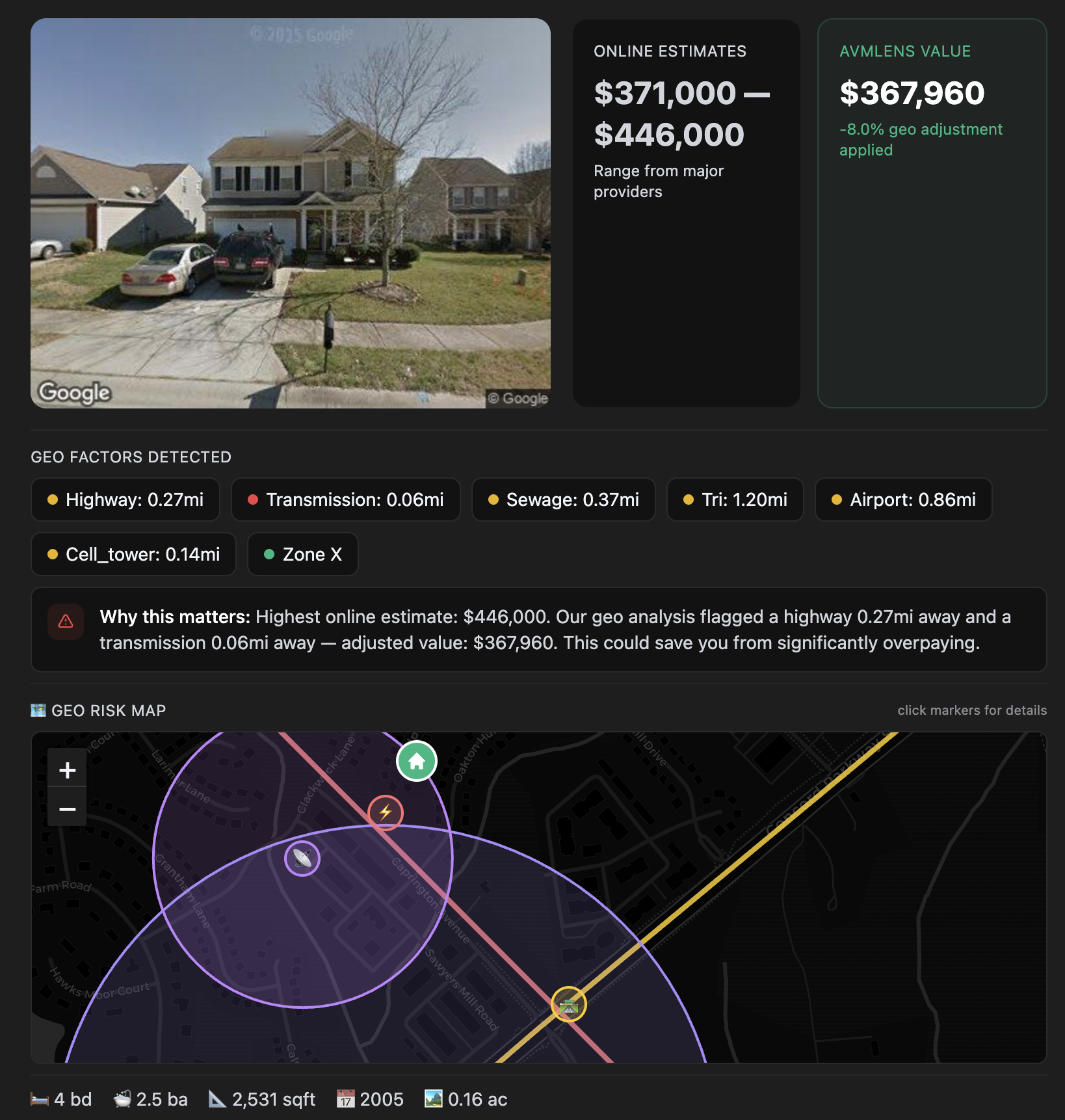
High-voltage transmission lines are one of the most significant - and most overlooked - factors in property valuation. While traditional AVMs like Zillow's Zestimate ignore proximity to power lines entirely, research consistently shows they create measurable price discounts.
We analyzed our database of property valuations to quantify exactly how much transmission lines affect property values based on distance and voltage.
The Data: Discounts by Distance
Our analysis looked at single-family homes within 1,000 feet of high-voltage transmission lines (230kV and above) compared to similar homes further away:
On a $400,000 home, that's a $32,000 discount if you're within 200 feet of high-voltage lines. This isn't theoretical - it shows up in actual sale prices.
Voltage Matters
Not all transmission lines are equal. Higher voltage lines have larger towers, more visual impact, and stronger electromagnetic fields - all of which increase the discount:
| Voltage Class | Typical Discount (within 300ft) | Visual Impact |
|---|---|---|
| 500kV+ | 8-12% | Massive steel towers, wide easements |
| 345kV | 6-9% | Large towers, noticeable hum |
| 230kV | 4-7% | Medium towers |
| 115kV | 2-4% | Wooden poles or small steel |
| <69kV | 0-2% | Distribution lines, minimal impact |
Why AVMs Miss This
Traditional automated valuation models compare your property to recent comparable sales. The problem: they don't systematically account for transmission line proximity in their comparisons.
If a house near a transmission line sells for $380,000, the AVM might use that as a comp for a similar house half a mile away that isn't near any lines. The result? The second house gets undervalued.
Conversely, if comps are pulled from properties away from lines, the AVM overvalues the house near the transmission line.
We identify transmission lines using utility infrastructure data and calculate exact distances to each property. Our geo-risk layer then applies appropriate adjustments based on voltage and proximity, giving you a risk-adjusted value rather than a naive estimate.
What Buyers and Sellers Should Know
For Buyers:
- Use transmission line proximity as a negotiating point - most sellers price based on raw AVM estimates
- Consider long-term resale: the discount will apply when you sell too
- Higher voltage = more impact. Check the voltage class, not just presence
- Easements may restrict what you can build on your property
For Sellers:
- Price realistically - overpricing leads to extended days on market
- Highlight other positives that offset the location
- Be prepared for buyers to bring up the lines during negotiation
The Perception Factor
Beyond measurable impacts, there's a significant perception factor. Surveys show:
- 62% of homebuyers say they would not consider a home near visible transmission lines
- 78% believe there are health risks (regardless of scientific consensus)
- 45% cite aesthetics as the primary concern
Even if you personally don't mind the lines, your future buyer pool is significantly reduced - which impacts value.
Bottom Line
Transmission lines create real, quantifiable impacts on property values. If you're analyzing a property within 500 feet of high-voltage lines, apply a discount of at least 4-8% to any AVM estimate.
Better yet, use a valuation tool that accounts for these factors automatically.
AVMLens automatically identifies transmission lines near properties and adjusts valuations accordingly. Try it free with 50 tokens.